
Sentry Air- Portable Clean Room (30" Wide Gen II)
Request a Quote For Pricing
For Quotes, simply add desired products to your quote request with the Add to Quote button. You can view your full request at any time by selecting the View Current Quote Request button on the sidebar. If you need assistance please call us at (888) 240-7247 or email sales@ironforgeindustrial.com
Senty Air Systems Improves Air Quality With High Efficiency Filtration & Versatile Solutions
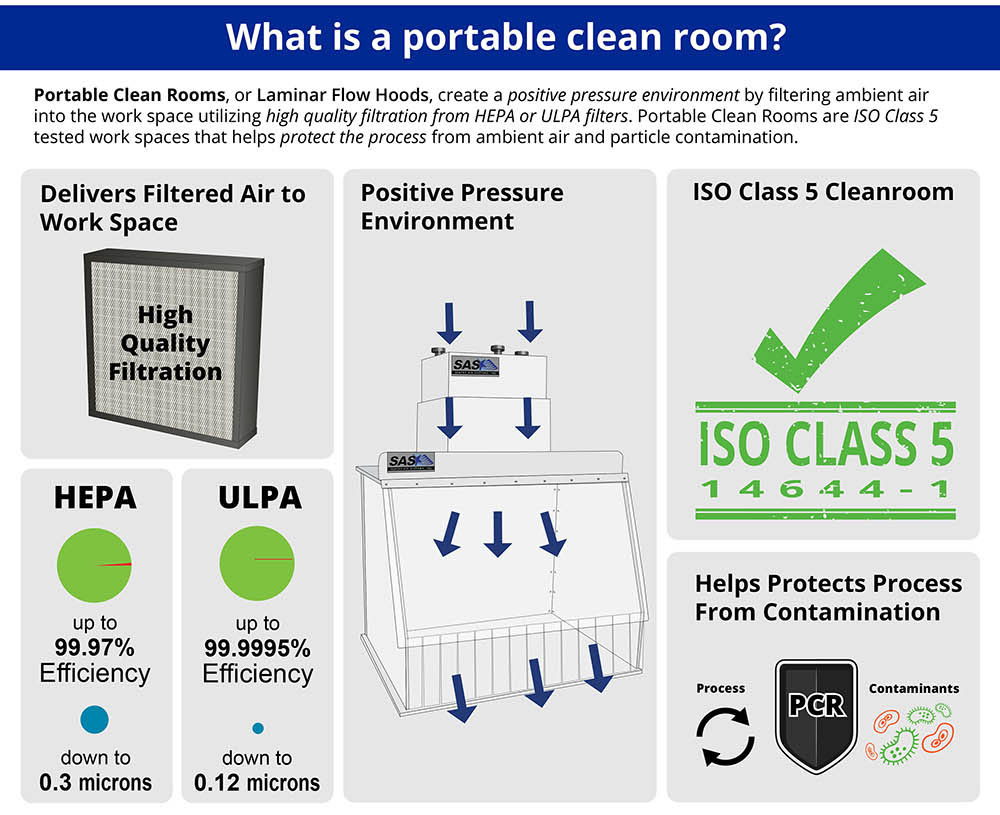
The Portable Clean Room is a compact positive pressure system that provides an exceptionally clean laminar airflow inside the hood. This system utilizes a dual-stage (single for PCR2) filtration process which consists of a MERV8 pre-filter and a HEPA filter with an efficiency rating of up to 99.97% efficient on particles 0.3 micrometers and larger. For applications requiring a higher efficiency, an ULPA filter is available with an efficiency rating of up to 99.9995% at 0.12 micrometers.
Traditionally, companies that desired a clean sterile workspace would have to convert an entire room into a HEPA-filtered positive pressure area and end up spending tens of thousands of dollars and taking up excess room. However, our portable clean rooms are designed to be cost-saving, by offering a compact solution that requires very little space and as much mobility as needed.
What is a Portable Cleanroom?
A Portable Cleanroom is a compact positive-pressure system that provides an exceptionally clean laminar (constant, nonturbulent) airflow inside the hood. Typically, a portable cleanroom is used in laboratory, medical, biological, electronics, food and beverage, and scientific applications and offers the ability to be more modular, and mobile than a typical cleanroom where a full room is converted into a controlled environment.
A cleanroom is a designated space or room where alterations are made in order to reduce/remove contamination of particulates, fumes, vapors, and toxins, as well as control the environment's temperature, allotted air pressure (or fan velocity), and room humidity.
What makes a Portable Cleanroom effective?
A key element in making a cleanroom effective is utilizing a HEPA ( high-efficiency particulate air) filter to trap particles down to 0.3 microns with 99.97% efficiency. The air pushed (or pulled) into a cleanroom is passed through the HEPA filter and provides a cleaner atmosphere for the application to be performed in and in the most strenuous cases, a ULPA (ultra-low particulate air) filter can capture particulates down to 0.12 microns with 99.9995% efficiency.
Benefits of a Portable Cleanroom
- ISO Class 5 Cleanroom - reduced contamination in the working environment
- Free-standing, modularity
- Minimal maintenance
- Modifications, customization available
- Compliance with government regulations
- Controlled environment to remove outside tampering
Portable Clean Room Models
Generation I
The original Portable Cleanroom – Generation I offers a simple ON/OFF operation and provides dependable and effective protection for your application. This economical unit helps your facility implement a cleanroom environment without a large investment.
Generation II
This upgraded version, Generation II, offers improved functions, design, and fan system. The front-facing variable speed controller allows the operator to easily adjust the fan speeds to suit their application. The running indicator light informs the user that the system is running. The improved design and fan system have increased the airflow and enhanced the system’s efficiency. Also, this new design allows operators to PAO test to check the filter for leaks and approve the device for certifications such as USP 797.
What is the Classification of a Portable Cleanroom?
Cleanroom classifications are defined simply by how clean the air in the room is. Federal Standard (FS) 209 (A - E) classifies a cleanroom as dependent on the number of particles in a working environment's air. More accurately, 'Cleanroom classification standards FS 209E and ISO 14644-1' require a particle count measurement and calculation in order to fully classify the "cleanliness" of an environment.
ISO 14644-1 Cleanroom Standards
 BS 5295 Cleanroom Standards
 * At Sentry Air Systems, our portable cleanrooms operate at an ISO 5 classification.
Portable Cleanroom Safety Considerations
The safe operation of your cleanroom is critical to protecting your application, staff, and anyone around it. A portable cleanroom should only be considered if safety measures and protocols are implemented and will be enforced by a safety engineer, or manager on hand. A few safety measurements that should be considered are:
- They should be visually inspected frequently
- Pedestrian traffic in front of the cleanroom should be limited
- Any bulky equipment should be placed at the rear of the hood
- To allow for airflow, large equipment should be raised at least 2” off the surface
- If your cleanroom is used often, a regular cleaning schedule should be established
Brochures (Specs)
Quick Compare

Portable Clean Room with UVC Controls

SAS Portable Clean Rooms with UVC utilize the documented power of UV lights to actively disenfect clean room environments from pathogens, germs, viruses and other hazardous bacteria. Offering a simple user interface, the Portable Clean Room with UVC is essential in protecting workers from the environment they are working with, and the respirable hazards they may be exposed to.
What is laminar air flow?
Laminar air flow is when a stream of constant air is provided with the same speed and direction, with no crossover of air stream. The Vertical Laminar Flow Hood is rated as an ISO Class 5 clean room cabinet. It protects the process by utilizing a vertical laminar flow pattern and dual-stage filtration system that delivers positive-pressure, purified air through a pre-filter and main filter. The main filter is typically either a HEPA or ULPA filter depending on the efficiency desired. The HEPA filter is up to 99.97% efficient on particles 0.3 microns and larger, while the ULPA filter is up to 99.9995% efficient on particles 0.12 microns and larger.